
Top 20 Animals Without Tail (With Pictures & Fascinating Facts)
Picture a gorilla, a frog and a starfish at the same party. Which one needs a tail to stay upright? None of them. These tailless animals show that a tail isn’t a must-have. Today you’ll meet 20 animals with no tails, plus pictures and fun facts.
You’ll learn why some animals have no tails. You’ll see how body balance works without one. You’ll also find out where these creatures live. One quick heads-up: a few animals on this list carry tiny stubs or tail-like parts. Each entry has a clear “Tail status” label, so you always know the truth.
What Are Animals Without Tails?
Animals without tails have no outward tail on their bodies. Some are animals born without tails. Their bodies never grew one. Others are animals that lose their tails during development. Frogs are the classic case. A tadpole swims with a tail. Then metamorphosis shrinks that tail away. A third group lost the tail over millions of years. That’s the evolution of tailless animals, and apes show it best.
Scientists use the word “tailless” loosely. Many naturally tailless animals still hide a tailbone inside the body. In humans that bone is the coccyx. It’s the tip of the vertebral column. Other species keep a tiny stub made of a few caudal vertebrae. Even so, people call them animals without visible tails in daily talk. This guide uses the same everyday meaning.
| Type | What it means | Example |
| True tailless | No outward tail at any age | Gorilla, octopus |
| Stub-tailed | A tiny stump or hidden tip | Hedgehog, wombat |
| Tail lost in growth | Tail shrinks during life | Frog |
List of 20 Animals Without Tails
This list mixes mammals, birds, amphibians and marine animals. That mix shows you different types of tailless animals from around the world. Some are wild animals without tails. Others are pets without tails. A few are small animals without tails that fit in your hand. Use the table below for a quick look.
See Also: Animals That Eat Seeds: 15 Seed-Eating Animals (Full List)
Here’s a handy tip. Check the “Tail status” line in every entry. It tells you if the animal is truly tailless or has a reduced tail. That label keeps things honest. It also helps you spot the examples of animals without tails that fit your own definition.
| Rank | Animal | Scientific name | Class | Habitat | Tail status |
| 1 | Human | Homo sapiens | Mammal | Worldwide | Coccyx only |
| 2 | Gorilla | Gorilla gorilla | Mammal | African forests | None |
| 3 | Orangutan | Pongo pygmaeus | Mammal | Borneo rainforest | None |
| 4 | Barbary macaque | Macaca sylvanus | Mammal | North Africa | Vestigial stub |
| 5 | Manx cat | Felis catus | Mammal | Homes and farms | None to stub |
| 6 | Guinea pig | Cavia porcellus | Mammal | Domestic | No visible tail |
| 7 | Hamster | Mesocricetus auratus | Mammal | Burrows | Tiny stub |
| 8 | Chinchilla | Chinchilla lanigera | Mammal | Andes | Short furry tail |
| 9 | Koala | Phascolarctos cinereus | Mammal | Eucalyptus forest | No visible tail |
| 10 | Wombat | Vombatus ursinus | Mammal | Australia | Tiny stub |
| 11 | Sloth | Bradypus spp. | Mammal | Rainforest | Tiny or none |
| 12 | Capybara | Hydrochoerus hydrochaeris | Mammal | Wetlands | No visible tail |
| 13 | Quokka | Setonix brachyurus | Mammal | Rottnest Island | Short thin tail |
| 14 | Hedgehog | Erinaceus europaeus | Mammal | Gardens | Tiny hidden tail |
| 15 | Frog | Order Anura | Amphibian | Worldwide | Lost as adult |
| 16 | Kiwi | Apteryx spp. | Bird | New Zealand | No visible tail |
| 17 | Manatee | Trichechus spp. | Mammal | Warm waters | Paddle tail |
| 18 | Octopus | Order Octopoda | Mollusc | Oceans | None |
| 19 | Sea star | Class Asteroidea | Echinoderm | Seabeds | None |
| 20 | Pika | Ochotona spp. | Mammal | Mountains | No visible tail |
Humans
You belong on this list too. Humans are primates with a coccyx where a tail once grew. This small bone sits at the base of your spine. It anchors several muscles and supports you when you sit. Our ancestors lost their tails as they began to stand upright. Walking on two legs improved locomotion and freed the hands for tools. That’s a big survival adaptation. Tail status: coccyx only. Fun fact: a human embryo briefly grows a tiny tail that later shrinks away.
Gorillas
Gorillas are the largest primates without external tails. Western gorillas (Gorilla gorilla) and eastern gorillas (Gorilla beringei) both lack them. Mountain gorillas belong to the eastern group. They live in the forests of Central Africa. A gorilla moves by knuckle-walking, which protects its fingers on the ground. Silverback males lead each troop. They show power with chest beats and loud calls. A strong back and heavy hips give them superb body balance. Tail status: none. Fun fact: gorillas build a fresh sleeping nest almost every night.
See Also: 30 Energy Animals in the World (With Pictures & Interesting Facts)
Orangutans
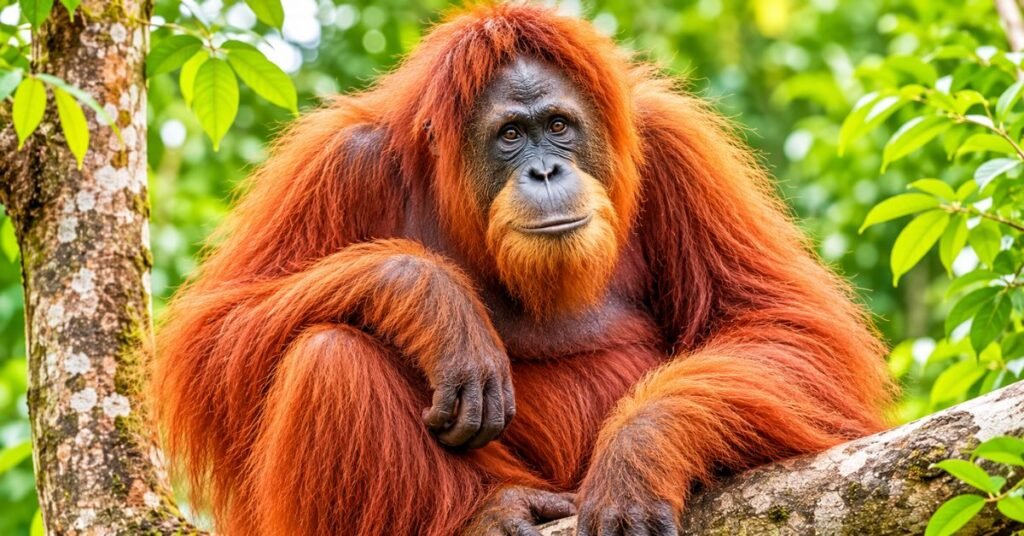
Orangutans are red-haired apes of Southeast Asian animal habitats. Three species exist. They are the Bornean (Pongo pygmaeus) and Sumatran (Pongo abelii) plus the Tapanuli (Pongo tapanuliensis). Their very long arms and flexible joints give them superb climbing ability. They move slowly through the canopy and test each branch. Each night they weave a fresh nest from leaves. Mothers raise their young for years. Tail status: none. Fun fact: orangutans have the longest childhood of any non-human primate.
Barbary Macaques
The Barbary macaque is a monkey. It isn’t an ape. Still it’s one of the best mammals with no visible tails. It carries only a tiny vestigial stub. These macaques live in the cedar forests and rocky hills of Morocco and Algeria. A small group also lives on Gibraltar. Troops spend hours grooming each other. That habit eases stress and builds trust. Strong limbs and a flexible spine handle the steep terrain. Tail status: vestigial stub. Fun fact: it’s the only macaque living outside Asia.
Manx Cats
Manx cats come from the Isle of Man in the Irish Sea. A genetic mutation causes their short or missing tails. Breeders call the tailless type “rumpy” and the short-tailed type “stumpy.” Long hind legs give them a bouncy run and strong jumps. Their inner ear and core muscles handle body balance with ease. However the same gene can cause spinal problems called Manx syndrome. Responsible breeding matters here. Tail status: none to short stub. Fun fact: old sailors thought Manx cats brought good luck.
Guinea Pigs
Guinea pigs are popular pets without tails. These rodents hide a small tail end under thick fur. Their wild relatives come from South America. The pet version exists only as a domestic animal. Guinea pigs live in social groups and chat with squeaks and whistles. They freeze or dash when scared. Their low, round body structure keeps them steady. They also can’t make their own vitamin C. Tail status: no visible tail. Fun fact: happy young guinea pigs leap in the air in a move called “popcorning.”
Hamsters
Hamsters are small animals without tails. The Syrian hamster (Mesocricetus auratus) has only a tiny stub. That stub is easy to miss under the fur. Wild hamsters dig deep burrows in dry regions. They fill their cheek pouches with seeds and carry the load home. The compact skeletal structure suits tunnels perfectly. A long tail would just get in the way. Tail status: tiny stub. Fun fact: a hamster’s cheek pouches can stretch far back along its body.
Chinchillas

Chinchillas deserve an honest label. They are animals with short tails. The tail is furry and about the length of a hand. So they aren’t truly tailless. We include them as animals with reduced tails next to the others. These rodents come from the Andes mountains of South America. They hop between rocks with ease. Their ultra-dense fur keeps them warm in the cold. They clean it with dust baths. Tail status: short furry tail. Fun fact: each hair follicle grows dozens of hairs.
Koalas
Koalas are marsupials from eastern Australia. They have no visible tail. The tail ends in padded fur that works like a seat cushion. Sharp claws and strong arms hug the tree trunk. That grip replaces the need for a tail. Koalas eat tough eucalyptus leaves. The leaves are low in energy. So koalas sleep up to 20 hours a day. Males bellow loudly in the breeding season. Tail status: no visible tail. Fun fact: koala fingerprints look almost like human ones.
See Also: Fluke vs. Flounder: 9 Key Differences You Need to Know in 2026
Wombats
Wombats are stocky marsupials that live in Australia. They have a tiny stub for a tail. Short legs and strong claws make them champion diggers. Their burrows protect them from heat and danger. A wombat can block its tunnel with its tough rear end. That hard bottom stops predators from following. Wombats eat grass and roots at night. Tail status: tiny stub. Fun fact: wombats produce cube-shaped droppings.
Sloths
Sloths live in the rainforests of Central and South America. Three-toed sloths (Bradypus) have a tiny stub. Two-toed sloths (Choloepus) show almost none. Curved claws let them hang upside down for hours. That posture saves energy and replaces a balancing tail. Their stomachs digest leaves very slowly. Green algae grows in their fur for camouflage. Sloths come down to the ground about once a week. Tail status: tiny or none. Fun fact: sloths can turn their heads about 270 degrees.
Capybaras
Capybaras are the giants of the rodents. They live near rivers and wetlands in South America. These wild animals without tails show no visible tail at all. Wide feet and slightly webbed toes help them swim well. Water also gives them an escape route from predators. Capybaras graze on grass and water plants. They live in big, friendly groups. Even birds sometimes perch on their backs. Tail status: no visible tail. Fun fact: they are the largest rodents on Earth.
Quokkas

Quokkas are small marsupials from Western Australia. Most live on Rottnest Island. Their tail is short and thin for a marsupial of this type. So they count as animals with reduced tails. Quokkas hop on strong hind legs. They also climb low shrubs for leaves. They store fat in their tails to survive dry spells. Their relaxed face looks like a permanent smile. Tail status: short thin tail. Fun fact: the quokka is often called the world’s happiest animal.
Hedgehogs
Hedgehogs are animals with tiny or hidden tails. The tail is only about an inch long and sits under the spines. These small mammals live in gardens and woodlands across Europe and parts of Asia and Africa. They hunt insects and worms at night. When danger comes they curl into a spiky ball. That defense matters more than any tail. In cold places they hibernate through winter. Tail status: tiny hidden tail. Fun fact: a hedgehog carries thousands of spines.
Frogs
Frogs show the frog life cycle and tail disappearance perfectly. They belong to the order Anura. That name means “without tail.” A tadpole swims with a long tail. During metamorphosis the body absorbs that tail as fuel. Strong hind legs then take over movement. Adult frogs leap and swim with great power. They breathe partly through moist skin. That’s why clean water matters so much to amphibians. Tail status: lost as adult. Fun fact: some frogs jump more than twenty times their body length.
Kiwi Birds
Kiwis are flightless birds from New Zealand. They have no visible tail and only tiny wings hidden in their feathers. They walk through forests at night. Their long beak has nostrils at the tip. That helps them sniff out worms in the soil. Whisker-like feathers near the face help them feel their way. A round body structure keeps them steady on the ground. Tail status: no visible tail. Fun fact: a kiwi lays one of the biggest eggs for its size of any bird.
Manatees
Manatees are gentle marine animals that glide through warm coastal waters and rivers. They need a clear label. They aren’t truly tailless. A broad paddle-shaped tail drives them through the water. It works more like a rudder than a classic tail. We include manatees to show how the functions of tails in animals can change. Some tails run a body. Others give animals with unique body features. Manatees graze on seagrass. Tail status: paddle tail. Fun fact: manatees can stay underwater for several minutes between breaths.
Octopuses

Octopuses are animals that never grow tails. They belong to the order Octopoda and have a soft, boneless body. Eight flexible arms handle swimming and gripping. They also squirt water for quick jet locomotion. No vertebral column exists in their bodies. So there are no vertebrae or tail bones either. They hide in dens and change color to blend in. Tail status: none. Fun fact: an octopus has three hearts.
Sea Stars (Starfish)
Sea stars are animals that lack tails. They follow a radial body plan with arms around a central disc. Hundreds of tiny tube feet let them crawl and grip. They live on seabeds around the world. Most hunt shellfish by pulling the shells open. Many can regrow a lost arm. They have no brain and no true blood. Tail status: none. Fun fact: some sea stars can regrow a whole body from one arm.
See Also: 25 Animals With Sharp Teeth (With Pictures & Fascinating Facts)
Pikas

Pikas are small relatives of rabbits. They live in cold mountain rock piles in Asia and North America. These mammals with no visible tails have round bodies and big ears. They gather grass all summer. Then they stack it into “haypiles” for winter food. Sharp, chirpy calls warn neighbors of danger. Short limbs and quick feet let them dart across the stones. Tail status: no visible tail. Fun fact: pikas are lagomorphs. They aren’t rodents.
Why Do Some Animals Have No Tails?
Tails do many jobs. They help with balance and swimming and signaling. Some grip branches. Others swat flies. When an animal stops needing those jobs the tail can shrink. That’s tail reduction through natural selection. Charles Darwin called this process “descent with modification.” Over many generations animals that evolved without tails passed on useful traits. Apes are the textbook case. They moved upright and swung through trees. They didn’t need tails for body balance. This is the evolution of tails in mammals in action.
Other causes exist as well. A genetic mutation can cause congenital taillessness. The Manx cat genetic mutation is the famous example. Tadpoles show a third route. Their tails vanish during metamorphosis. Octopuses and sea stars never had tails at all. Think of a tail as a spare battery. Some species stopped needing it. Case study: on the Isle of Man the mutation spread through a small island cat population. People then prized the look and kept breeding it. The result was a whole breed of tailless species. The importance of tails in animal movement is real. Yet these animals prove it’s not universal.
How Do Animals Without Tails Maintain Their Balance?
Balance starts in the inner ear. Tiny fluid-filled canals sense every tilt and turn. The brain then adjusts the muscles within a split second. A strong core and powerful hind legs also help. Many animals that do not need tails for balance have a low center of gravity. That’s how tailless animals maintain balance on the ground. Their skeletal structure and body structure do the work a tail once did.
Grip, posture and water help too. Koalas and sloths hug branches with sharp claws. Upright apes shift their weight with their hips. Manatees and capybaras get lift from water. These physical characteristics act as survival adaptations. Together they show animals without tails and their behavior can stay smooth and sure. Here’s a quick view of the main balance tools.
| Animal | Main balance tool |
| Gorilla | Strong back and hips |
| Koala | Gripping claws |
| Sloth | Hanging posture |
| Manx cat | Long hind legs and inner ear |
| Capybara | Wide feet and water buoyancy |
| Frog | Powerful hind legs |
Tailless Animals vs. Animals With Short or Vestigial Tails
A vestigial tail is a leftover tail that no longer does its old job. It may be a tiny stump or just a few caudal vertebrae. Animals with vestigial tails include the Barbary macaque and the wombat. Animals with short tails include the quokka and the chinchilla. True tailless animals show nothing at all. Gorillas and octopuses fit that group. These are differences between tailless and short-tailed animals. They help you sort examples of naturally tailless wildlife from near matches.
Many lists blur this line. That’s because the stump is often hidden under fur. Here’s a simple rule of thumb. If you can’t see a tail from the outside, call it tailless. If you can see even a small one, call it short-tailed. Of course the coccyx and the tailbone remain inside many species. This is why scientists focus on vertebral column details more than looks.
| Category | Examples | What you’d see |
| True tailless | Gorilla, octopus, sea star | No tail at all |
| Vestigial stub | Macaque, wombat, hamster | A tiny bump or hidden tip |
| Short or reduced tail | Quokka, chinchilla | A small but visible tail |
Where Do Animals Without Tails Live?
Tailless animals and their habitats cover almost every corner of Earth. Gorillas and sloths live in rainforests. Pikas climb cold mountains. Wombats and koalas roam Australian woods and hills. Hedgehogs and Manx cats share our gardens and farms. Humans live everywhere. These animal habitats show the true reach of mammals and primates without outward tails.
Water habitats matter too. Frogs live in ponds and wetlands. Capybaras and manatees use rivers and coasts. Octopuses and sea stars live on the seabed. Every continent has some wild animals without tails. If you want to check conservation status you can visit the IUCN Red List or the Smithsonian’s National Zoo for animal profiles.
| Region | Examples |
| Africa | Gorilla, Barbary macaque |
| Asia | Orangutan, pika |
| Europe | Hedgehog, Manx cat |
| North America | Pika, frog |
| South America | Capybara, sloth, chinchilla |
| Australia and Oceania | Koala, wombat, quokka, kiwi |
| Oceans | Octopus, sea star, manatee |
Final Thoughts
Tails are handy tools. Yet this guide shows they aren’t required. From apes to frogs these tailless mammals and amphibians found other ways to thrive. They use strong limbs and clever posture. Their animals with unique body features help them climb and swim. Learning about animals without tails also helps you see how evolutionary adaptation works across the animal kingdom.
So which tailless animal is your favorite? Maybe it’s the smiling quokka or the cube-dropping wombat. Share your pick in the comments. You can also explore our other animal guides for more surprising facts.
Frequently Asked Questions
What animal has four legs and no tail?
Many animals fit this description. Frogs and guinea pigs have four legs and no visible tail. So do koalas and capybaras. Pikas fit too. These animals rely on strong limbs and good body balance instead of a tail.
Are all animals have tails?
No. Many animals have no tail at all. Humans and octopuses don’t have one. Sea stars have none either. Adult frogs lose theirs during metamorphosis. Tails are common but they aren’t universal.
Does a snake have a tail?
Yes. A snake’s tail is the part of the body behind the vent. The vent is the opening near the end of the body. Everything before it is the trunk. Everything after it is the tail.
Do any gorillas have tails?
No. Gorillas are apes and lost their tails long ago in evolution. Adult gorillas have no external tail at all. They keep a small tailbone inside the body like humans do.