20 Animals with Big Eyes That Will Surprise You (With Pictures)
Have you ever locked eyes with a slow loris and felt like it could read your mind? Big eyes do that to us. They make animals look curious, alert, and sometimes downright adorable. But those giant eyes aren’t just for charm. They’re survival tools shaped by millions of years of evolutionary adaptation.
In this guide, you’ll meet 20 fascinating animals with big eyes, from tiny jungle primates to giants of the deep ocean. You’ll learn why these big-eyed animals evolved such large eyes, how their eye anatomy helps them survive, and which creatures have the most prominent eyes relative to their body size. Whether you love cute animals with big eyes or want hard facts about animal eyesight, this list has something for you.
Why Do Some Animals Have Big Eyes?
Big eyes usually mean one thing: the animal needs serious night vision. Many nocturnal animals are active when the sun goes down, so their eyes grew larger over time to soak up every bit of available light. This kind of nocturnal adaptation helps them hunt, forage, and avoid becoming someone else’s dinner in the dark.
Size also plays a role in predator detection and spotting prey. A bigger eye can capture more light and detail, giving the animal sharper visual acuity. This is why so many wild animals with big eyes live in dim forests, deep oceans, or come out only at night. Their eyes are basically nature’s version of night-vision goggles, built right into their skulls.
What Makes an Animal’s Eyes So Large?
The secret lies in eye anatomy. Animals with oversized eyes often have a bigger cornea and a wider pupil, which lets in more light. Behind that, a dense layer of rod cells in the retina boosts sensitivity to low light. Some nocturnal species even have a mirror-like layer called the tapetum lucidum, which reflects light back through the retina for a second chance at detection. That’s why cats and many other night hunters seem to have glowing eyes in the dark.
This kind of eye size adaptation isn’t random. It’s tied directly to habitat and lifestyle. A creature living in a rainforest canopy or a deep ocean habitat faces very different lighting challenges than one living in open grassland. Over generations, visual adaptation shaped each species’ eyes to match its world, giving us today’s incredible variety of large-eyed creatures.
There’s also a trade-off involved. Bigger eyes need bigger sockets, and bigger sockets take up space in the skull. That space has to come from somewhere, often the jaw or the braincase. So when you see a large-eyed creature, you’re looking at an animal that made a real evolutionary bet. It gave up skull space and sometimes bite strength in exchange for sharper enhanced eyesight. For nocturnal hunters and prey animals alike, that bet usually pays off, which is exactly why the trait keeps showing up again and again across totally unrelated branches of the animal kingdom.
List of Animals with Big Eyes
Below, you’ll find 20 remarkable species with large eyes, each with its own story. Some are small animals with big eyes, built for stealth and precision. Others are marine animals with big eyes, adapted to a world with almost no light at all. Let’s take a closer look at each one.
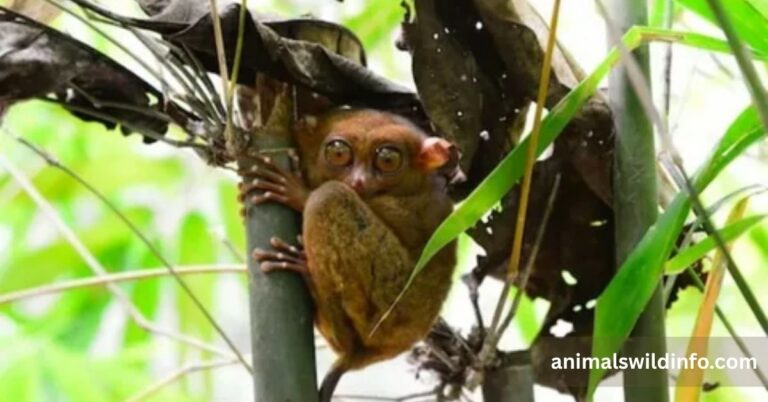
Tarsier
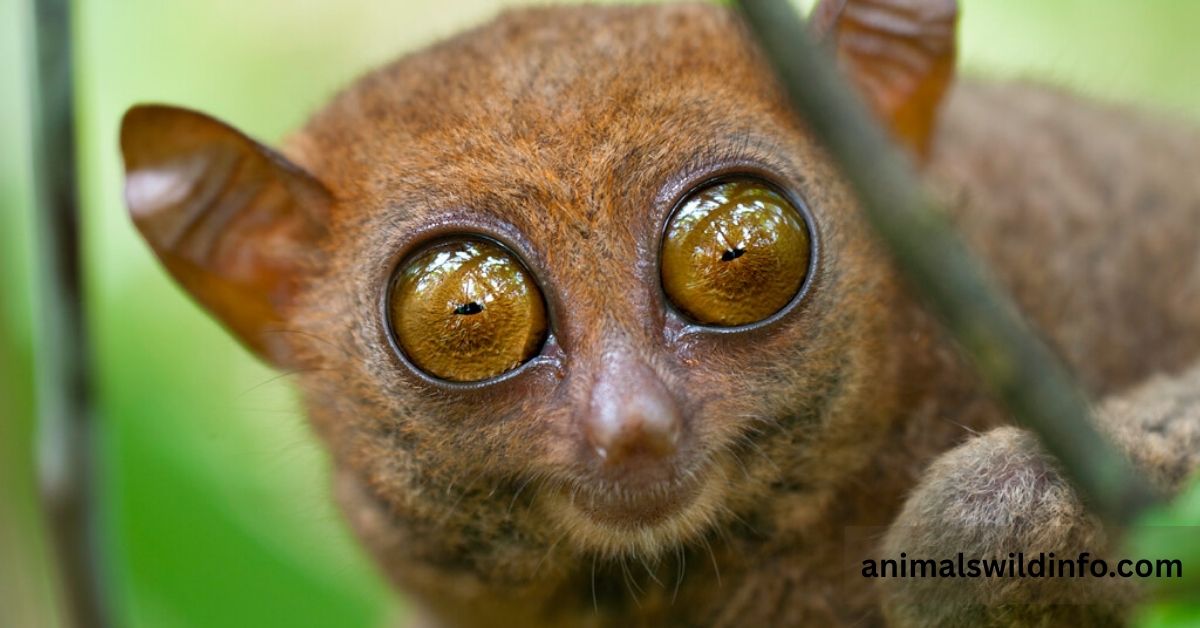
The tarsier might be the poster child for big-eyed mammals. This tiny primate, found in Southeast Asia, has eyeballs so large that each one weighs more than its entire brain. That’s not an exaggeration. Its eyes are fixed in their sockets, so the tarsier can’t roll them around like we do. Instead, it rotates its head almost all the way around to scan its surroundings.
This extreme oversized eyes trait gives the tarsier incredible low-light vision, perfect for its life as a nighttime hunter. It leaps between branches in total darkness, snatching insects out of the air with startling accuracy. Its hunting behavior depends almost entirely on those massive eyes, since it can’t rely on scent or sound the way other predators do. For a creature barely the size of a fist, the tarsier proves that enhanced eyesight can make up for a whole lot of size disadvantage.
Tarsiers also have unusually long back legs, built for powerful vertical leaps between tree trunks. Combined with their wide-eyed stare and swiveling head, they can track a moving insect, judge the distance, and launch themselves at it in a split second. Unlike most primates, tarsiers are almost entirely carnivorous, feeding on insects, small lizards, and even birds. This makes their hunting behavior more similar to a small owl than to a typical monkey, and their giant eyes are the tool that makes the whole strategy possible.
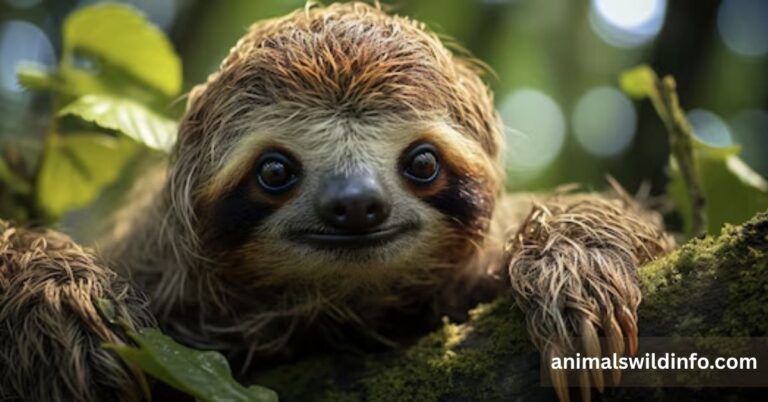
Slow Loris
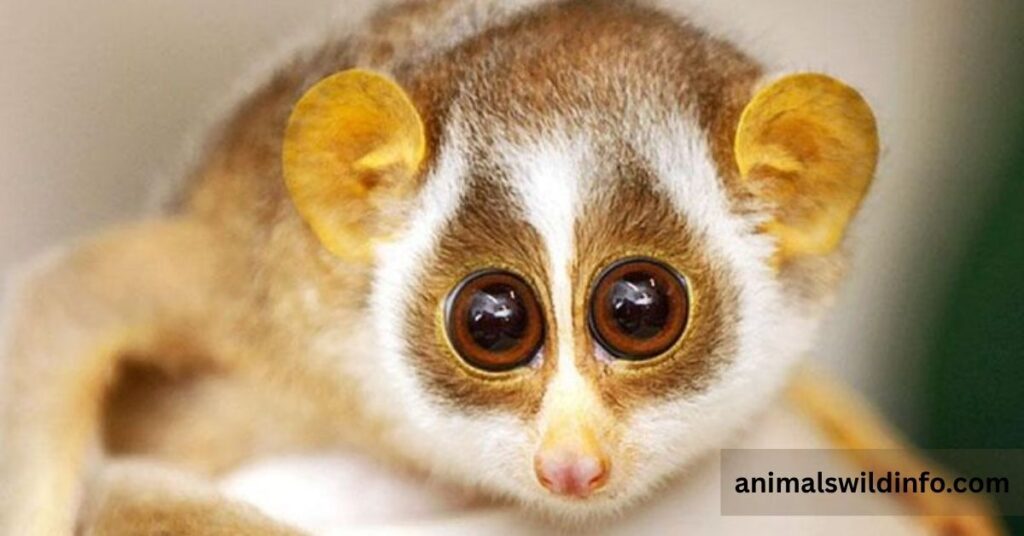
Native to the forests of Southeast Asia, the slow loris has round, saucer-like eyes that make it one of the most recognizable cute animals with big eyes. But don’t let the innocent look fool you. This creature is one of the few venomous mammals on Earth, producing toxins from glands near its elbows.
Its nocturnal adaptation allows it to move slowly and deliberately through the treetops at night, using its large eyes to spot fruit, insects, and small prey in near-total darkness. The slow loris relies on stealth rather than speed, creeping along branches while its eyes track every shadow and movement. Sadly, its charming appearance has made it a target for the illegal pet trade, putting real pressure on wild populations. Conservationists now use its popularity as a chance to teach people about protecting nocturnal wildlife instead of capturing it.
Slow lorises also move at an oddly deliberate pace compared to most tree-dwelling mammals. Rather than leaping like a bushbaby or a tarsier, they grip branches tightly with strong hands and creep forward one careful step at a time. This slow, quiet style of movement, paired with keen low-light vision, lets them sneak up on sleeping birds and insects without alerting them. It’s a completely different hunting behavior strategy than speed-based predators use, proving that patience can be just as effective as quickness in the wild.
Read More: 25 Animals That Gallop (With Pictures and Fun Facts)
Bushbaby (Galago)
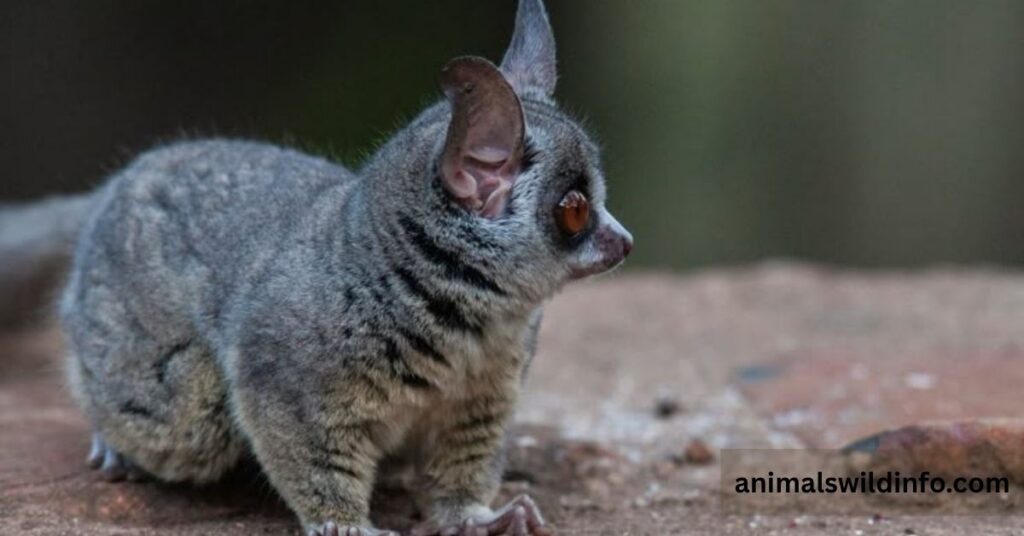
The bushbaby, also called a galago, has eyes that can take up nearly half its face. This African primate is built entirely around a life lived after dark. Its giant eyes give it a huge field of vision, letting it spot both danger and dinner in the black of night.
Beyond its eyes, the bushbaby is famous for its jumping ability. It can leap distances many times its own body length, bouncing from tree to tree like a furry pinball. This combination of excellent eyesight and explosive leg power makes it one of the most agile arboreal lifestyle specialists in the animal kingdom. Its calls, which sound eerily like a crying baby, give it its unusual name, adding another layer of mystery to this small but mighty creature.
Bushbabies also rely on strong hind legs, built almost like tiny springs, to power those incredible jumps between branches. Their large eyes work together with excellent hearing, since their oversized ears can rotate independently to pinpoint the exact location of a rustling insect. This combination of enhanced eyesight and directional hearing makes the bushbaby one of the most efficient nighttime foragers in the African forest, able to detect a moving cricket from several feet away in near-total darkness.
Aye-Aye
Found only in Madagascar, the aye-aye looks like something out of a fantasy movie. Its enormous eyes, combined with bat-like ears and a strange, skeletal middle finger, make it one of the most unusual primates alive. Those big eyes are essential for its nighttime lifestyle, giving it the low-light vision it needs to move safely through dense forest.
The aye-aye uses a hunting method called percussive foraging. It taps on tree bark with its long middle finger, listening for hollow sounds that reveal insect tunnels underneath. Once it finds a target, it gnaws through the wood and fishes out the insect with that same specialized finger. Its eyes help it track subtle movements and shadows while it works, proving that visual adaptation and unusual anatomy can combine into a truly one-of-a-kind survival strategy.
Local folklore in Madagascar has long treated the aye-aye as an omen, sometimes even a symbol of bad luck, largely because of its strange appearance. This reputation has actually put the species at risk, since some communities kill aye-ayes on sight out of superstition. Wildlife groups are now working to shift that perception, highlighting the aye-aye’s gentle nature and its important role in controlling insect populations within its forest habitat.
Tree Frog
Tree frogs bring a splash of color to the list of amphibians with big eyes. Their bulging eyes sit high on their heads, giving them a wide field of vision to spot predators lurking in the leaves above and below. This wide view is critical, since tree frogs are small and vulnerable to birds, snakes, and other predators.
Interestingly, many tree frogs have eye colors that blend with their skin, creating natural camouflage. When a tree frog sits still on a leaf, its eyes can almost disappear into the background, making it harder for predators to notice. This clever mix of camouflage and sharp eyesight helps the tree frog survive in a world where nearly everything is bigger and hungrier than it is.
Many tree frog species also use their large eyes for a defensive trick called a startle display. When threatened, some frogs open their eyes wide and flash bright, contrasting colors hidden underneath their eyelids, briefly startling a predator just long enough to escape. This split-second reaction shows how eye anatomy in amphibians with big eyes can serve more than one purpose, blending vision, camouflage, and defense into a single evolved feature.
Owl
Owls are some of the most famous birds with big eyes, and for good reason. Their eyes are so large that they take up a huge portion of the skull, leaving little room for movement. Because owls can’t roll their eyes, they’ve evolved the ability to turn their heads up to 270 degrees, giving them something close to panoramic vision without ever needing to move their bodies.
Their retina is packed with rod cells, tuned specifically for detecting movement in dim light. This gives owls incredible motion detection skills, letting them spot the twitch of a mouse from high above in near darkness. Combined with silent flight and sharp talons, an owl’s eyes turn it into one of nature’s most efficient nighttime hunters. It’s no wonder owls have long been symbols of wisdom and mystery across cultures worldwide.
Owl eye color also hints at behavior patterns. Species with yellow eyes, like the great horned owl, tend to hunt mainly after dark, while owls with darker, almost black eyes are often more active during dawn and dusk. This subtle difference in eye anatomy across owl species shows just how finely tuned evolutionary adaptation can get, adjusting not just eye size but even color based on exactly when an animal needs to see best.
Chameleon
Chameleons are famous for changing color, but their eyes deserve just as much attention. Each eye can move completely independently of the other, giving the chameleon something close to 360-degree vision. One eye can watch for predators behind it while the other tracks a juicy insect ahead.
This unique setup gives chameleons excellent depth perception once both eyes lock onto the same target. That precision matters, since chameleons catch prey using a long, sticky tongue that shoots out faster than the human eye can follow. Between the color-changing skin and the wildly independent eyes, chameleons are proof that reptiles with large eyes can be just as strange and wonderful as any mammal or bird.
Each chameleon eye sits inside a cone-shaped turret, covered almost entirely by skin except for a small opening for the pupil. This unusual structure protects the eye while still allowing an incredibly wide field of vision in every direction. When a chameleon spots prey, both eyes suddenly swing forward together, locking onto the target and giving the animal sharp binocular vision for the split second it needs to strike with total accuracy.
Gecko
Geckos might not have the biggest eyes on this list, but they punch above their weight when it comes to night vision. Many gecko species are strictly nocturnal, and their eyes are built to gather light far better than human eyes ever could. Some scientists believe certain geckos can even perceive color in conditions so dark that humans would see only black and white.
Their pupils often narrow into thin vertical slits during the day, then open wide at night to let in maximum light. This flexible eye size adaptation allows geckos to move confidently across walls and ceilings after dark, hunting insects with precision. It’s a small but powerful example of how visual adaptation can turn a modest lizard into a nighttime hunting machine.
Unlike many reptiles, most gecko species also lack eyelids. Instead, they use their long tongues to clean dust and debris directly off the surface of their eyes. This unusual habit, paired with their exceptional low-light vision, makes geckos one of the more unique reptiles with large eyes on this list, blending strange behavior with genuinely impressive sensory ability.
Read More: 30 Most Energetic Animals on Earth (Ranked by Speed, Stamina & Activity)
Dragonfly
Dragonflies take the concept of big eyes to an entirely different level. Instead of two simple eyes, a dragonfly has compound eyes made up of thousands of tiny lenses, sometimes numbering close to 30,000 per eye. This gives it an almost complete 360-degree vision, letting it spot movement from nearly every direction at once.
This incredible field of vision makes the dragonfly one of the most successful aerial hunters in the insect world. It can track and catch prey mid-flight with a success rate that puts many predators to shame. Its eye anatomy is so advanced that researchers studying animal eyesight often use dragonflies as a model for understanding compound vision systems in nature.
Dragonflies also process visual information incredibly fast, reacting to movement far quicker than the human eye can register. Some studies suggest dragonflies can predict the future flight path of prey, adjusting their own trajectory mid-air to intercept a target before it even changes direction. This blend of speed and motion detection places the dragonfly among the most efficient predators in the entire insect world, despite its small size and delicate wings.
Zebra Jumping Spider
The zebra jumping spider might be tiny, but its eyes tell a big story. This little arachnid has four pairs of eyes, each serving a different purpose. The two large front eyes provide sharp depth perception, letting the spider judge distances with impressive accuracy before it pounces on prey.
This precise depth perception is what allows the zebra jumping spider to leap onto insects several times its own body length away, almost never missing its target. Its side eyes act like a built-in alarm system, detecting motion detection cues from predators approaching from any angle. Altogether, this spider is a masterclass in how multiple eyes can create a complete visual defense and offense system in a body smaller than a fingernail.
Unlike web-building spiders that rely mostly on vibration, jumping spiders hunt visually, stalking prey slowly before launching a calculated leap. Their large front eyes even show researchers something close to curiosity, tracking moving objects and sometimes appearing to “study” them before deciding whether to attack or retreat. This behavior makes the zebra jumping spider one of the more surprisingly intelligent species with large eyes in the insect and arachnid world.
Sugar Glider
The sugar glider is a small marsupial from Australia with eyes that seem almost too big for its face. As a nocturnal animal, it relies heavily on those large eyes to navigate the treetops after dark, gliding from branch to branch using a thin membrane stretched between its limbs.
Its big eyes give it strong low-light vision, helping it judge distances accurately before each glide. Missing a landing at night, high in a tree, isn’t an option for a creature this small. Beyond survival, sugar gliders are known for being social and expressive, often forming tight family groups. Their large, dark eyes add to their reputation as one of the most cute animals with big eyes kept as exotic pets today.
Sugar gliders live in small family colonies and communicate constantly through soft barks, chirps, and hisses. Their large eyes also help them read social cues from other gliders, since much of their nighttime activity happens in tight-knit groups moving together through the canopy. This social side, combined with their gliding skill and low-light vision, makes the sugar glider one of the more behaviorally complex small animals with big eyes on this entire list.
Japanese Dwarf Flying Squirrel
This adorable rodent looks almost like a plush toy, with round eyes that dominate its tiny face. Native to Japan, the dwarf flying squirrel uses its oversized eyes to navigate forests at night, gliding silently between trees using flaps of skin stretched between its front and back legs.
Because gliding at night is risky business, this squirrel depends on sharp enhanced eyesight to judge branch distances and avoid obstacles in near darkness. A single miscalculation could mean a dangerous fall. Its combination of tiny size, huge eyes, and gliding ability has made it one of the most beloved small animals with big eyes in wildlife photography and social media alike.
This species is considered a natural monument in parts of Japan, protected due to its rarity and cultural significance. Its round face, tiny nose, and enormous dark eyes have made it something of an internet celebrity in recent years, even though sightings in the wild remain rare. Researchers studying wildlife adaptation often point to this squirrel as a textbook example of how oversized eyes and gliding membranes can evolve together to support a very specific nighttime lifestyle.
Pygmy Marmoset
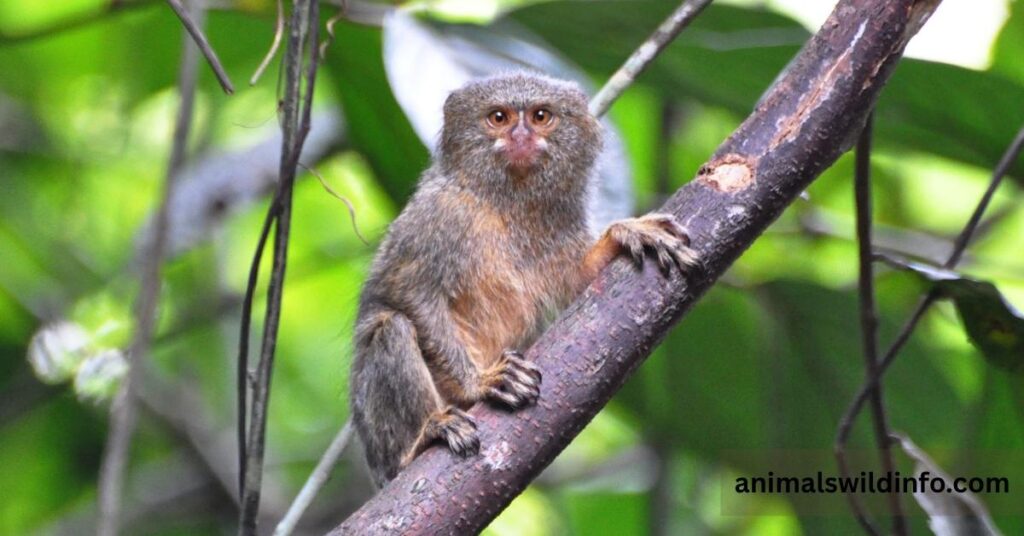
Known as the world’s smallest monkey, the pygmy marmoset packs a surprising amount of personality into its tiny frame. Its large eyes help it forage at dusk, spotting insects and ripe fruit hidden in the dense foliage of South American rainforests.
These primates live in tight family groups, and their expressive eyes play a role in social bonding as much as survival. High-pitched calls combine with visual cues to help coordinate group movement through the trees. As one of the more charming rainforest animals, the pygmy marmoset shows how big eye animal traits can support both hunting behavior and complex social life at the same time.
Despite its small size, the pygmy marmoset is a surprisingly skilled climber, using sharp claws instead of nails to grip tree bark securely. It often feeds on tree sap, gouging small holes in bark and returning to the same spot repeatedly. Its keen eyesight helps it remember these feeding locations across its territory, showing that enhanced eyesight supports memory and navigation just as much as it supports spotting predators or prey.
Margay
The margay is a small wild cat native to Central and South America, and it’s built almost entirely for a life in the trees. Its large eyes give it outstanding night vision, letting it stalk prey through dense forest canopy long after the sun goes down.
What makes the margay especially remarkable is its ankle flexibility. Unlike most cats, it can rotate its ankles nearly 180 degrees, allowing it to climb down trees headfirst like a squirrel. Combined with sharp predator detection skills and excellent binocular vision, the margay is one of the most specialized arboreal lifestyle hunters among all wild cats.
Margays are also known for an unusual hunting trick. Some researchers have documented margays mimicking the calls of prey animals, like baby monkeys, to lure curious targets closer before striking. This clever combination of vocal deception and sharp night vision shows just how sophisticated hunting behavior can get among forest habitat predators, even in a cat barely bigger than a house pet.
Rabbit
Rabbits are well known for their floppy ears, but their eyes deserve equal credit. Positioned on the sides of the head, a rabbit’s eyes give it an almost complete panoramic vision, allowing it to spot predators approaching from nearly any direction without turning its head.
This wide field of vision is a critical predator avoidance strategy, since rabbits are prey animals for countless species. Their eyes also reveal emotion. Calm rabbits have soft, relaxed eyes, while frightened ones show dilated pupils and a more alert stare. This blend of survival function and expressive behavior makes rabbits one of the most familiar big-eyed mammals in backyards across the United States.
Rabbits also have a small blind spot directly in front of their nose, which is why they often rely on whiskers and smell to inspect food up close. But everywhere else, their vision is remarkably sharp, especially when it comes to detecting motion. A hawk circling far overhead or a fox creeping through tall grass rarely goes unnoticed, thanks to this powerful combination of panoramic vision and constant predator avoidance instincts built directly into their daily behavior.
Lemur
Lemurs, found only in Madagascar, are known for their enormous, expressive eyes and playful personalities. These primates rely on strong low-light vision to move through the forest at night, searching for fruit and leaves while avoiding predators lurking in the shadows.
Beyond survival, lemur eyes play a big role in social behavior. Group members often communicate through eye contact, signaling curiosity, caution, or playfulness to one another. Their golden irises give them an almost hypnotic gaze, which has helped make lemurs one of the most photographed wild animals with big eyes in nature documentaries and zoos around the world.
Madagascar is home to more than a hundred distinct lemur species, each with slightly different eye shapes, colors, and sizes depending on their specific niche. Some species, like the aye-aye’s distant cousins, are almost entirely nocturnal, while others are active during the day and rely less heavily on low-light vision. This variation makes lemurs one of the best case studies for understanding how eye evolution in animals adapts differently even within a single, closely related family.
Sphynx Cat
Unlike the wild species on this list, the Sphynx cat is a domestic breed known for its hairless body and dramatically large eyes. Its lack of fur makes those wide, expressive eyes stand out even more, giving the breed an unmistakable and slightly otherworldly look.
Sphynx cats are famous for their curious, mischievous personalities, and their big eyes seem to reflect that energy constantly. While their vision isn’t dramatically different from other domestic cats, their prominent eyes combined with hairless skin create one of the most visually striking big-eyed mammals in the pet world. It’s easy to see why so many owners describe their gaze as almost human-like.
Goldfish (Telescope Goldfish)
The telescope goldfish is a specially bred variety known for its dramatically protruding eyes, which sit on short stalks extending from the sides of its head. This unusual trait developed through selective breeding rather than natural evolutionary adaptation, making it one of the more artificial examples of animals with bulging eyes.
While the look is striking, those bulging eyes come with a downside. Telescope goldfish generally have weaker eyesight than standard goldfish, making them more vulnerable in tanks with sharp decorations or aggressive tankmates. Owners often keep them in calm, gently decorated aquariums to protect their delicate, oversized eyes from injury. It’s a fascinating case of human breeding creating a trait that looks impressive but doesn’t necessarily improve survival.
Giant Squid
Deep beneath the ocean’s surface lives one of the most mysterious deep sea animals on Earth, the giant squid. Its eyes can grow nearly as large as a basketball, making them the biggest eyes of any known animal. This isn’t just for show. In the pitch-black deep ocean habitat, every bit of light matters.
These massive eyes help the giant squid detect faint traces of bioluminescence, the natural glow produced by many deep-sea creatures. Spotting this glow from a distance gives the squid crucial warning about approaching predators, including sperm whales, one of its only natural threats. Researchers believe this extreme eye size adaptation evolved specifically to detect large, slow-moving light disturbances in total darkness, making the giant squid a true champion among marine animals with big eyes.
Ostrich
The ostrich holds the title for the largest eyes of any land animal, with each eyeball measuring close to two inches across, larger than its own brain. As the world’s biggest flightless bird, the ostrich relies on these massive eyes to scan the open plains of Africa for approaching predators.
Positioned high on its head, an ostrich’s eyes provide a wide field of view without needing to move much at all. Since ostriches can’t fly away from danger, they depend on early predator detection combined with incredible running speed, reaching over 40 miles per hour when they need to escape. This mix of sharp eyesight and raw speed makes the ostrich one of the most well-equipped birds with big eyes for survival in wide-open terrain.
Read More: 22 Most Docile Animals in the World (With Pictures)
Animals with the Largest Eyes Relative to Their Body Size
When you compare eye size to body size, the rankings change completely. A giant squid has huge eyes in absolute terms, but relative to its massive body, a tiny tarsier or dragonfly actually wins by a landslide. This comparison reveals just how extreme some evolutionary adaptation patterns can get in the animal kingdom.
| Animal | Eye Size | Body Size | Eye-to-Body Ratio |
| Tarsier | Around 16mm diameter | Roughly 4-6 inches tall | Extremely high |
| Giant Squid | Up to 10 inches diameter | Up to 43 feet long | Moderate (largest eyes overall) |
| Dragonfly | Thousands of lenses per eye | 2-5 inches long | Extremely high |
| Ostrich | About 2 inches diameter | Roughly 9 feet tall | Moderate |
| Bushbaby | Up to 50% of face size | 6-8 inches tall | Extremely high |
Why Big Eyes Help Animals Survive
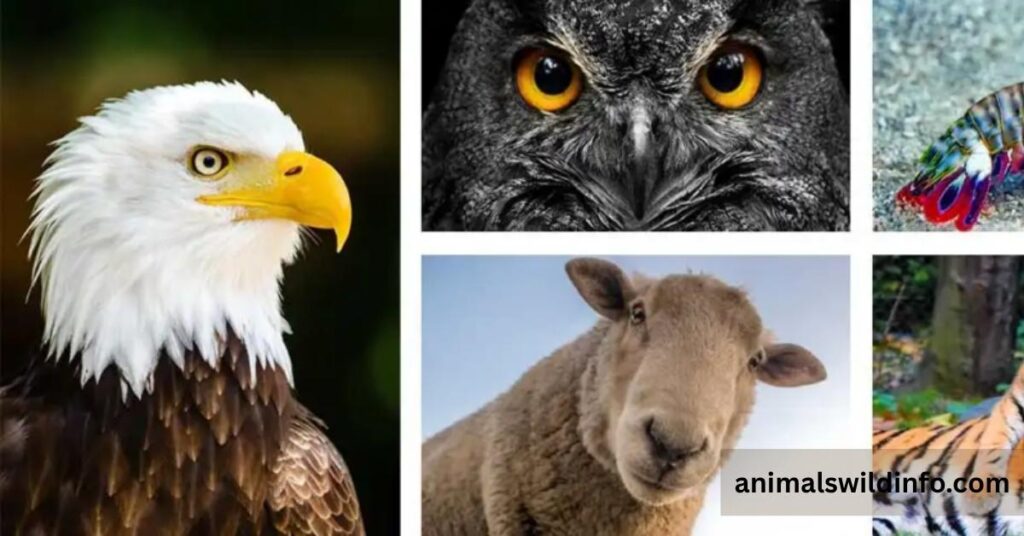
Big eyes aren’t just an interesting quirk. They’re a core survival adaptation built through generations of pressure from predators, prey, and environment. Animals with large eyes typically enjoy sharper motion detection, stronger depth perception, and better performance in low-light conditions than their smaller-eyed relatives.
This advantage shows up everywhere in nature, from forest habitat dwellers avoiding predators to ocean creatures hunting in total darkness. Strong eyesight often means the difference between catching dinner and going hungry, or between spotting danger in time and becoming someone else’s meal. Whether it’s a rabbit’s panoramic vision or an owl’s razor-sharp night hunting, big eyes give animals a real edge in the constant push and pull of animal behavior and survival.
Big eyes also shape how animals interact socially, not just how they hunt or hide. Many primates, including lemurs and marmosets, use eye contact to communicate mood, curiosity, or warning within their groups. Meanwhile, prey species like rabbits use subtle eye movements to signal alertness to others nearby, spreading awareness of danger through an entire group in seconds. This dual role, supporting both animal senses and social communication, shows that wildlife adaptation rarely serves just one single purpose. Evolution tends to stack multiple benefits onto a single trait whenever it can, and big eyes are a perfect example of that efficiency at work across the animal kingdom.
Fun Facts About Animals with Big Eyes
Nature loves to surprise us, and big eyed animals are full of strange and wonderful trivia. The giant squid’s eyes are so sensitive that scientists believe they can detect the movement of large predators from over 100 feet away in total darkness. That’s an incredible feat considering how little light exists at those ocean depths.
Ostriches have eyes bigger than their own brains, a fact that never fails to surprise people learning about wildlife facts for the first time. Dragonflies, meanwhile, have eyes made of nearly 30,000 individual lenses, giving them one of the most complex visual systems in the entire insect world. Even the humble tarsier, barely bigger than a human fist, has eyeballs so large it physically cannot move them in their sockets. These quirky details remind us just how creative adaptation in nature can really be.
Owls are also famous for their extreme neck flexibility, able to rotate their heads roughly 270 degrees in either direction without cutting off blood flow to the brain, a special adaptation that supports their limited eye movement. Chameleons take independent vision even further, since each eye can focus on a completely different object at the same time, essentially giving the brain two separate video feeds to process simultaneously.
FAQs
Which animal has the biggest eyes in the world?
The giant squid holds the record, with eyes that can grow nearly as large as a basketball. This makes it the undisputed champion among animals with prominent eyes, adapted specifically for detecting faint light in the deep ocean.
Which small animal has the biggest eyes?
The tarsier is often considered the winner here, since its eyes are larger than its own brain despite its tiny body size. The pygmy marmoset and bushbaby also rank among the top small animals with big eyes relative to their size. Interestingly, insects like the dragonfly complicate this ranking further, since their compound eyes contain thousands of individual lenses rather than a single large orb, making direct comparisons tricky but no less impressive.
What is the cutest animal with big eyes?
This one comes down to personal taste, but the slow loris, sugar glider, and Japanese dwarf flying squirrel consistently top the list of cute animals with big eyes in polls and social media rankings. Pygmy marmosets and Sphynx cats are frequent runners-up, thanks to their expressive gazes and photogenic faces.
What animals have big eyes?
Tarsiers, owls, giant squids, chameleons, and rabbits are just a few examples of animals with large eyes, spanning mammals, birds, reptiles, and marine life.
What animal has big eyes?
The tarsier is one of the most extreme examples, with eyes so large relative to its body that it cannot move them within their sockets.
Who animal has 8 eyes?
Spiders, including the zebra jumping spider, typically have eight eyes arranged in pairs, giving them excellent depth perception and wide-angle motion detection.
Which mammal has big eyes?
The slow loris, sphynx cat, tarsier, and bushbaby are all strong examples of big-eyed mammals, each using their eyes for either night vision or social expression. Lemurs and sugar gliders round out the list, showing that this trait spans continents, habitats, and entire branches of the mammal family tree.
Conclusion
Big eyes open a window into how animals experience the world differently than we do. Whether it’s a big eye animal hunting silently through the rainforest canopy or a deep-sea giant scanning for danger in total darkness, these creatures remind us that animal eyesight is one of nature’s most impressive tools.
Understanding these adaptations doesn’t just satisfy curiosity. It deepens our respect for the incredible biodiversity sharing our planet, and the delicate ecosystem balance that keeps it all thriving.